Saturday, September 14, 2013

Cluster Beans Stir Fry/ Mitki Sang Uppkari (Konkani) / Gorikayi Palya (Kannada)

The Guar or cluster bean (Cyamopsis tetragonoloba) is an annual legume. The health benefits of cluster beans are in the protein and fiber they provide. The cluster beans are not only low in calories but are also very effective in lowering the blood sugar and cholesterol levels. From this we can make stir fry, or can be used in sambar or even can we used in any vegetable recipe of your choice. I made a very easy recipe which was indeed tasty. Here I used sambar powder, which gave a great taste to the stir fry.
Ingredients:
Cluster Beams chopped- 3 cups (wash the beans in water and chop evenly)
Mustard 1 tsp
3 springs Curry leaves
2 green chillies chopped
2 tbsp grated coconut
1 tbsp sambar powder
Salt to taste
Coconut oil 2 tbsp
Method:
  • Take a kadai, add oil, drop in the mustard seeds, when they start to splatter add the curry leaves and green chilli. Saute for a minute in low flame. 
  •  Add the chopped Cluster beans, stir fry for 2-3 minutes.
  •  Add the grated coconut, fry for a minute.
  •  Add the Sambar powder, salt to taste and mix well. Let the flame be at medium while you stir fry the contents well. [Addition of sambar powder really gives nice taste to this recipe]
  • Just sprinkle 1/4 cup water, (Do not add more water). Let it stay dry. Close the vessel with lid, cook the beans in low flame for 5-8 minutes. When done Serve it along meals (Rice+ Sambar/ or any curry)

Padmashree Raikar
@ gHara javaN

Friday, September 13, 2013

Moode/Mude ('Kedige' Flavored Idlis)

Moode/Mude is a very traditional Mangalorean recipe! Moode with mooga ghasssi (sprouted moong dal curry) is a must for breakfast. It can also go well with sambar and coconut chutney. Its a most time made during festive occasion which includes Krishna janmastami, Chaturti and even during Deepavali.
Moode idli batter is steamed in molds made from Kedige leaves (Screw pine), before these molds were made at home, now we purchase it in Mangalore stores. Kedige leaves gives a very special aroma and flavor to the idlis. Moode is usally prepared during festivals and weddings and the molds are available at Mangalore stores during festivals. Moode is very easy recipe, you need a right proportion of Rice and black lentil (Urad dal). I just love this along any veg or even non veg curry!

Ingredients:
1 cup urad dal (Soaked in water for about 4-6 hours, best is 6 hrs)
3 cups idli rava or rice rava/ or 2 cups White rice (Soak white rice in water for 4-6 hours,  I have used rice rava 3 cups and have soaked it for 6 hours)
Salt as per taste

 Method:
  • Grind the soaked urad dal to a smooth dal until it froths up and increases in quantity.
  • Wash the idli rava and drain out all the water; Add rava to the urad batter and blend well both the contents (About 3-5 minutes). If you are using soaked white rice, drain out all the water and grind until it gets to coarse consistency paste (rice batter can be little course rather than smooth fine).
  • Transfer into a large mixing bowl and let ferment overnight or for 8-10 hours; Add salt and mix well.
  • Pour into moode ele (kedige moulds) and steam cook for about 20-25 minutes; Moode is done when no grains stick to the fork when pierced.
  •  Remove from stove and serve hot with coconut chutney, sambar, gashi or any other side dish of your choice.
 

NOTE:
  • It is important to ensure that moode ele stays upright while it cooks. You wouldn't want the moode to fall off and let the water from the bottom of the cooker get in. So, I place each moode separately inside long steel tumblers.
  • To remove the moode from the mould, slowly pull out the tiny sticks that hold the mould together; The mould will fall apart automatically. 

Padmashree Raikar
@ gHara javaN 

Saturday, August 31, 2013

Colocasia or Taro Leaf rolls/ Patrado (Konkani)

Patrado (konkani) Rolls made of colocassia leaf multilayered with masala and steamed.

Yesterday I had a yummy patrado. It was raining heavy & I enjoyed my dinner with steaming boiled rice mixed with lemon dal sar along patrado topping it with coconut oil...woaw what could be better than this hmmmm.

Patrado is a Konkani delicacy made with Patrade paan(konkani) or colocassia leaf. It is mostly found in abundance during the rainy season and is grown in backyard kitchen gardens.
During rainy season leaves grow in abundance & also is found to cause less itching than the rest season.

My backyard with patrade paan widely grown 
Patrade paan (konkani) can cause itching in the hands while handling them due to the calcium oxalate. This can be avoided by rubbing hands with tamarind juice/ lemon juice before handling taro leaves.
Patrado is also garnished with coconut oil to prevent itching in the throat. The secret to tasty patrado also lies in using tender or young taro leaves as opposed to larger taro leaves.
We used to keep the remaining patrado the next day, which was shallow fried with rice powder mixed with chili powder. This makes great patrado phodi. I loved it along kanji or even curd rice. My all time favarate.


Some experimentation in masala:
We can prepare the patrado paste using different combination of  green gram (moong), toor dal, rice along chilly.In this recipe below 50% moong, 25% rice, 25% grated coconut is used for stuffing into leaves.
Other variations are :

1) 100 % whole moong 
2) 75% whole moong or moong dal and 25 % rice 
3) 50 % toor dal and 50 % rice 
4) 50 % chana dal and 50% rice 
5) 25 % chana dal 25 % moong dal and 50 % rice. 
My mom would prepare it mostly with moong dal and rice along grated coconut. Its good to use moong dal  as its much lighter on the tummy than chana dal.


Method:
Grind to smooth paste the roasted red chilli 8-12, 1/2 coconut grated, overnight soaked green gram 1 cup, half cup soaked(2 hrs) rice, 1 tb sp jaggery powder, small pinch asafoetida, medium tamarind pulp, salt to taste... (some also add, 1 tb sp roasted coriander seed, 1 tb sp jeera instead of asafoetida)

  • Now take cleaned Patrado (colocassia leaf ) remove the stem and veins.
  • Take a plain clean surface place 1 big leaf add the paste and spread all over the leaf..Then keep another leaf on the left side, covering half side of the first leaf...Apply little paste and spread over it. Then keep third leaf on the right side in the same manner. Thus apply leaf & paste alternatively & evenly. Repeat it same way to make 8 to 10-12 layer of leaf.
  • Now first turn inside all the 2 sides of this pile and then roll it completelly and tie the roll with a thread if you need to keep the roll firm.

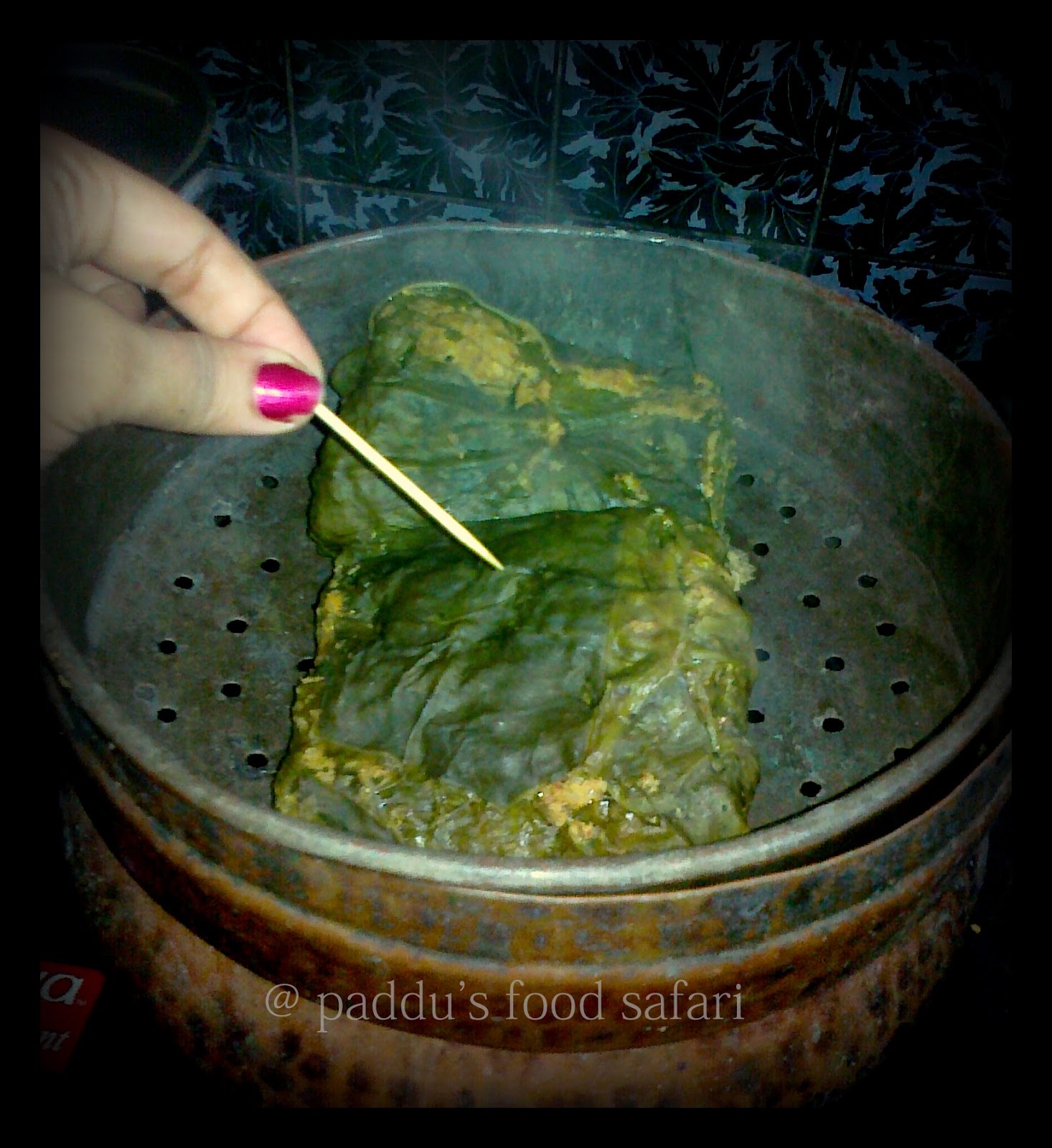
  • Keep the roll in a steaming vessel and cook in steam for 20 min till its done.

  • Check if the roll is cooked well by poking using a tooth pick, you should see the the masala don't stick to the tooth pick. After it cools down a little, remove the thread and make slices.
  • Have them by adding ghee/coconut oil or deep fry them to eat or shallow fry them. Goes great with a simple tomato sar/dal and rice...
Patrado along coconut oil
Padmashree Raikar
@ gHara javaN

Friday, August 30, 2013

Gova Pitta Undo/ Wheat Flour laddoo

Wheat Flour Laddu is very easy and simple traditional konkan/maharastrian recipe. It needs only few ingredients but finally when laddu is ready its very tasty. This laddu is very nutritional and it is especially made during Krishna Janmastami, Chaturti and also specially made for ladies who are expecting. I made this laddu during Krishna Janmastami. This recipe can be made very quickly, but needs some exact measurement of Ghee and sugar along wheat flour, which helps in making of round laddu's. Some do add milk, but it comes as halwa consistency. I haven't added liquid content. It is purely made using ghee. Make one when you find free, I am sure you will love it!!!

Ingredients:
Wheat Flour- 1 Cup
Sugar - 1 cup
5 Cardamom pods
Ghee- 50 gm
2 tbsp cashew pieces (You can also ass raisens/badam/pista pieces)

Powdering of sugar:
This is best way I feel.
Grind the sugar along the cardamom pods to fine powder.

Method:
  • Take a wide kadai, add 25 gm of ghee, when it melts add the cashew pieces. Fry till cashew is slight brown. See that you keep the flame medium throughout the process
  •  Add the wheat flour and roast on low heat until it turns golden brown in color and aromatic.
  • Here you can see the wheat flour has changed the color. Add the powdered sugar and combine the roasted flour, powdered sugar well just for 2 minutes. Remove from heat.
  • When warm and easy enough to handle, divide the mixture into parts and roll them into balls.
  • If the mixture is little dry to make balls, add some ghee (I have added remaining 25 gms of melted ghee).
  • Leave to cool so that they firm up.
Padmashree Raikar
@ gHara javaN

Thursday, August 22, 2013

SHAHI PANEER

Shahi paneer is a typical North Indian dish eaten with with roti, chappati, nan or other Indian breads.
Shahi paneer is preparation of paneer pieces in a thick, creamy and spicy gravy prepared in tomato, onion and cashewnuts paste. Here I have added poppy seeds too, as it helps the gravy to be thick and also it enhances the taste. Paneer is the Indian word for cottage cheese, and shahi is the Indo-Persian term for royal (in reference to the Mughal court) as information through Sources available.

Ingredients:
200 gms paneer (cottage cheese), cut into even size cubes
2 medium onions chopped 

1 tbsp poppy seeds
1 cup cashew nut (kaju) paste [Soak 2 fist full of cashews & poppy seeds in warm water, then grind to smooth paste using milk cream/ or even milk is fine]
1 1/2 tsp ginger-garlic (adrak-lehsun) paste (Choice, but i hav used paste as well as chopped pieces)
1 big tbsp chilli paste [I have ground fresh red chilli to fine paste]
4 tbsp tomato puree
1/2 tsp garam masala
1 star anise
1" Cinnamon stick (cut into 2-3 smal piece)
3 cardamom pods
4 cloves
1/2 tsp chilli powder
1 tsp Shahi jeera
1 tsp coriander powder
1/2 tsp cumin powder
2 tsp fine chopped garlic
2 tsp fine chopped ginger
1/2 tsp turmeric powder (haldi)
1 tsp coriander (dhania) powder
2-3 tbsp Coconut oil for shallow frying paneer

2 tbsp coconut oil + 1 tbsp Ghee
For garnish fine chopped cilantro leaves/ melted butter [Choice]

Method:
  • Cut the paneer into even size cubes.
  • Shallow fry the Paneer until they are golden brown and keep aside.
  • Take a Kadai, add coconut oil and ghee, fry the spices (star anise, cloves, cinnamon, cardamom, shahi jeera) untill you get the pleasant smell. Add the ginger-garlic chops followed by onions and salute well till it gets golden brown. 
  • Add the coriander powder, cumin powder, turmeric powder, chilli powder, garam masala powder, salt to taste and fry well for 2-3 mins. Now add the tomato puree and chilli paste. Now cool this masala mixture to room-temperature and grind it to a paste. Again transfer this masala paste to kadai. [You can also add 1-2 green chilli here]
  • Grind the cashew and poppy seeds along milk to fine smooth paste. [You can also strain it through fine mesh strainer, in order to get a smooth paste]. Now add the Cashew paste into the ground masala content and saute well for 5 minutes. Adjust the salt if needed. Now add adequate quantity of milk (milk : water -> 1:1 ratio) to bring the masala mixture to gravy consistency, the poppy seed added along cashew paste helps the gravy to get thickened (Do not make the gravy dilute add little by little mater to check the thickness of the gravy).
  • Now when the curry is getting to boil add the fried paneer and cook for another 2-3 minutes. Switch off the burner, garnish with fine chops of coriander if needed. You can also top it with some butter. Serve along chapati/nan/dosa/ Rice. Its Yummmmm and creamy rich recipe and healthy too :)

Padmashree Raikar
@ gHara javaN

Sunday, August 18, 2013

Baby Corn Dum Biryani

This is a delicious Dum Biryani (spiced rice dish) which is the perfect main meal. Dum refers to a slow cooking method, where the rice and masala is placed in layers and dough is used to create a tight seal to prevent steam from escaping. The steam helps the spices to infuse the rice and create a wonderful aromatic flavour. I made the dum preparation using cooker. You can see my previous posts of Dum Biryani explanation. This is a simple Veg Biryani with a strong aroma of spices. Make one and enjoy with family!
Ingredients: 
Baby Corn- 8-10 chop horizontally
Dabur Basmati- 2 Cups [Soak previously for 30 mins]
Mint 2 cups fine chpped [For layering during Dum preparation]
Coriander 2 cups fine chopped [For layering during Dum preparation]
5 onions fine chopped.
2 tsp Ginger chops
2 tsp Garlic chops
Whole spices:
Star anise-3 No
Cinnamon Stick 2" [break it into small 3-4 pieces]
4 white Cardamom pods
1 black Cardamom pod
1 tbsp Snauf
2 tsp Black Pepper Corn
1 tbsp Cumin seeds
3 Red chilli
2 tbp Coriander powder
1 tsp Cumin powder
1 tsp Garam masala powder
1 tbsp Red chilli powder
Green Paste: Grind following to fine paste
1 Fist full - Mint chops
1 fist full- Coriander chops
5 Garlic flakes
1" Ginger piece
4 Green chilli
4 tbsp Yogurt
Method:
  • Take a medium size Pressure cooker, add 2 tbsp coconut oil and 1 tbsp ghee. Start to fry the spices one by one (Cumin seeds. cloves, start anise, Cardamon, cinnamon sticks, snauf, black pepper corns).
  • When you smell the pleasant aroma of the spices, add the ginger-garlic. Saute well for a minute and then add onions. 
  • Let the onions turns golden brown. After which add the Garam masala powder, Cumin
    powder, Red chilli powder, Coriander powder, 3 red chilli (whole break in hands). Saute well for 2-3 minutes.

  • Now add the Baby corn and saute well for 2-3 minutes. Add the green paste and let the whole masala cook for about 3 minutes, till the raw flavor of the green masala is gone. 
  • Now next step you can start preparing for the Dum. Take a part of the masala and keep aside (you need it for layering).
Rice Preparation:
  • Basmati Rice cooking procedure:
    • 2 cups of Dabur Basmati rice (Washed well and soaked for 30 mins, For 2 cups of rice add 4 cups of water).
    • Cook the Basmati in a wide vessel.
    • First let the water boil well, after which add the drained basmati & little of salt. Let it boil well for 2-3 mins under high flame, after which close the lid and keep the flame to lowest heat. The Rice will need 10-15 minutes to get cooked. (See that you don't add much salt here).
    • For first layering we are using 50-60% cooked rice, second layer will have 80% and final third layer will have 90% of cooked rice.
Making of Dum:
  • Keep watching the rice, it should only cook to specified percentage. When you see its done transfer the upper layer onto the Corn masala which is ready, this will be your first layer (50-60%) as you can see in the picture. (You will see little bit water while transferring rice, and this will be absorbed while it is cooked along Masala under Dum, so don't worry with it)
  • Now layer it with some chopped mint leaves and coriander leaves and 2-3 tbsp of Kesar water (choice).
  • Again add the second layer (80%) of the rice.
  • To the second layer add the remaining of the Corn masala which you had taken before.
  • Add the last (third) layer (90%) of Rice, followed by mint and coriander leaves. Top a little of ghee & 2-3 tbsp of Kesar water (choice).
  • Now close the lid and keep the heat to lowest and let the contents get cooked in lower heat for 15-20 minutes. [REMEMBER WE ARE NOT USING THE WHISTLE HERE]
Serve along Raita/ or mirchi ka salan or any curry of your choice


Padmashree Raikar
@ gHara javaN